Nike: Career transition support
In 2020, NIKE, Inc. was preparing to significantly reduce their workforce of 80,000+ employees. There was a critical need to provide impacted teammates with career and layoff-related resources once they no longer had internal access to company resources. I was on a four-person tiger team tasked with designing and building their experience.
Objective
Give former employees an easy way to access exit benefits after leaving Nike
Challenges
Exit benefits were scattered across systems and vendors with no single entry point
The content addressed job loss, so tone had to be direct without being cold or making assumptions about the attitudes of former employees
Tight timeline for multiple approvals
My role
Partnered with product design, user research and engineering to design, build and launch a comprehensive 0 to 1 off-boarding site that enabled former employees to access critical information
Wrote all UX copy across web and mobile experience ensuring it was clear, direct, concise and respectful
Developed site taxonomy
Met localization and translation requirements
Designed and launched within a week
SurveyMonkey: Content design lifecycle
In 2022, after recognizing broken communication channels, I facilitated a 5-hour workshop series to optimize our cross-functional content workflow.
Objective
Document a foundational, repeatable process for designing SurveyMonkey content
Challenges
Copy and documentation produced by multiple teams with different levels of resourcing
Unclear roles and responsibilities
Confusion on end-to-end customer journey
My role
Facilitated a user experience sprint outlining the customer journey we were targeting alongside our content production lifecycle. In the sessions we did the following exercises:
What content do customers need? Together we looked at a customer journey, customer feedback, and known pain points. Each team marked where they know content is needed both internally and externally.
How does content get created? Each team filled out a “recipe” card where they answered a series of “where, who, how, what” questions about their content production process. We discussed the cards to align on roles and responsibilities along with what we needed from one another to produce high-quality content.
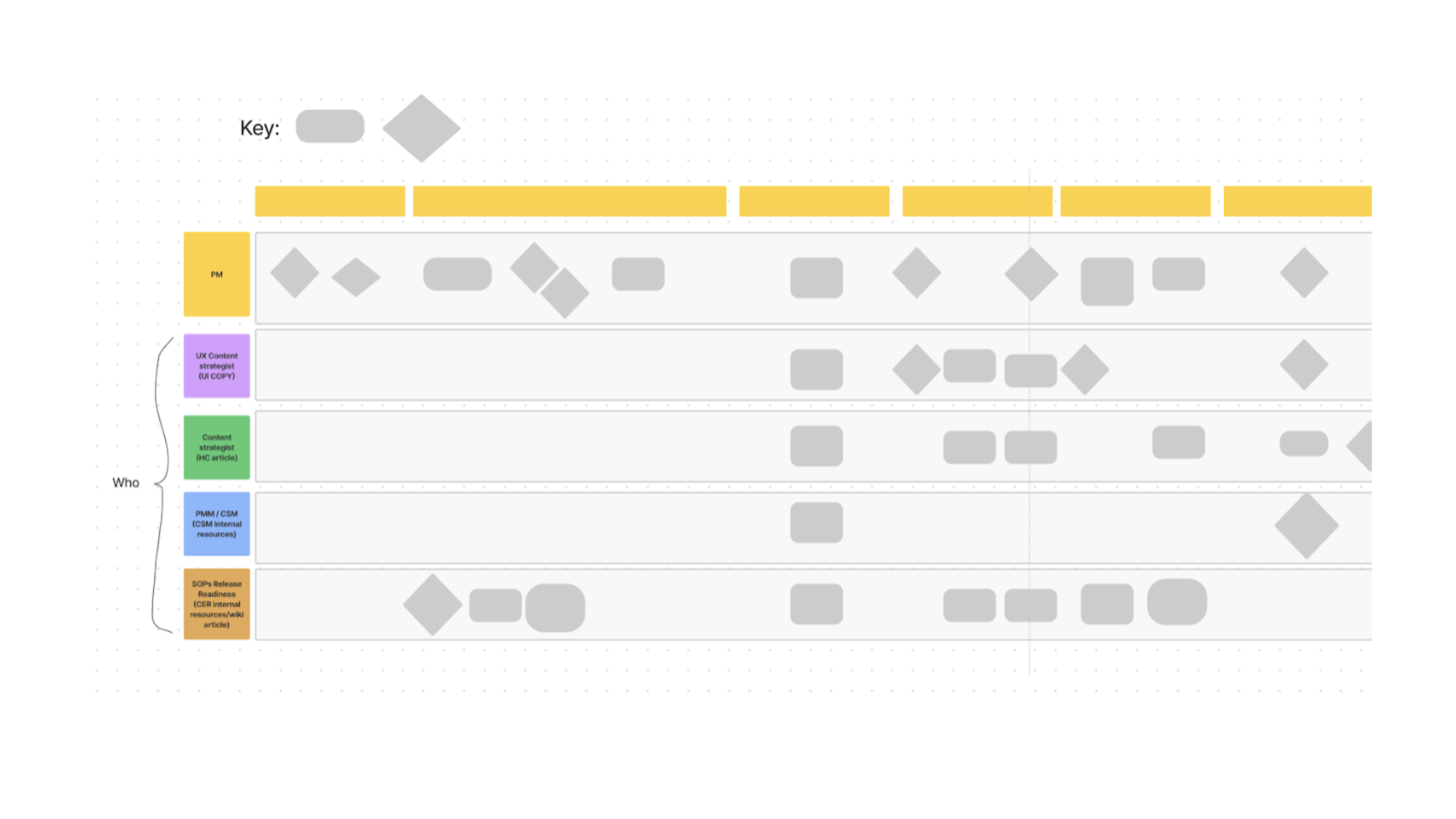
Put it on a timeline! We took the actions and deliverables from the recipe card exercise and arranged them on a general product manager timeline. This helped the team see where our work converged and diverged so we could set expectations for reviewing the work of other teams.
Impact
After implementing and scaling out the working process, teams across disciplines were communicating better and getting content produced with noticeably less back and forth.
Feedback from participants:
“Definitely the best run of any meetings I’ve attended at Survey Monkey!”
— participating product manager
“To put it plainly: Emily is going above and beyond what is expected of her. Her dedication to ensuring we all communicate better is like the rising tide raising all boats”
— participating UX writer

Lyft: Round up & donate
In 2017, Lyft launched a 0 to 1 feature allowing passengers to opt in to round up fares to the nearest dollar and donate the difference. I partnered with the product and support teams to anticipate where users would need help and ensured passengers had accurate help center content at launch.
Objective
Launch a charitable feature without causing downstream support tickets or dead-end user journeys
Challenges
MVP launch would require manual fixes for certain edge cases
Designing pathway for escalating anticipated issues to engineering
Ensuring the most essential information was in the product flow and the help center didn’t do unnecessary heavy lifting
My role
Service design specialist on core product launch team serving as liaison between support and product functions
Designed help center and associate content
Developed support launch plan
Consulted on UI/UX copy
Analyzed support tickets after launch
Impact
The feature had a successful, well-received launch and continues raising money for charitable causes. As of 2025, the feature has raised over $42 million for nonprofits across the United States